n4
Python oracle
nirs4all Python
v1.4.7
The Python oracle/reference implementation for the ecosystem: declarative NIRS pipelines over the native nirs4all-methods operators, and a unified API over scikit-learn, TensorFlow, PyTorch and JAX. Train, explain, and export portable .n4a bundles or cross-language model envelopes.
n4s
Desktop app
nirs4all Studio React · Electron
v0.15.2
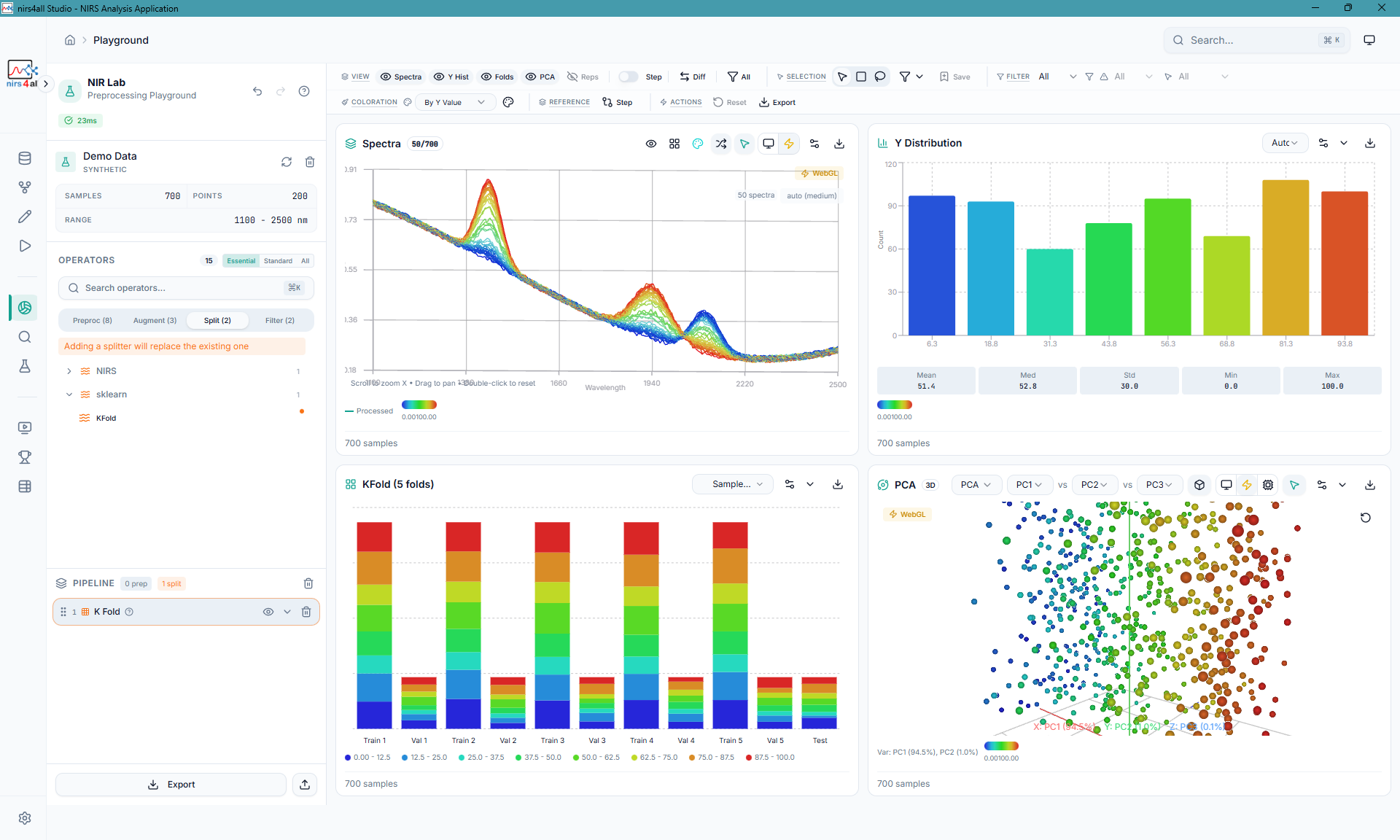
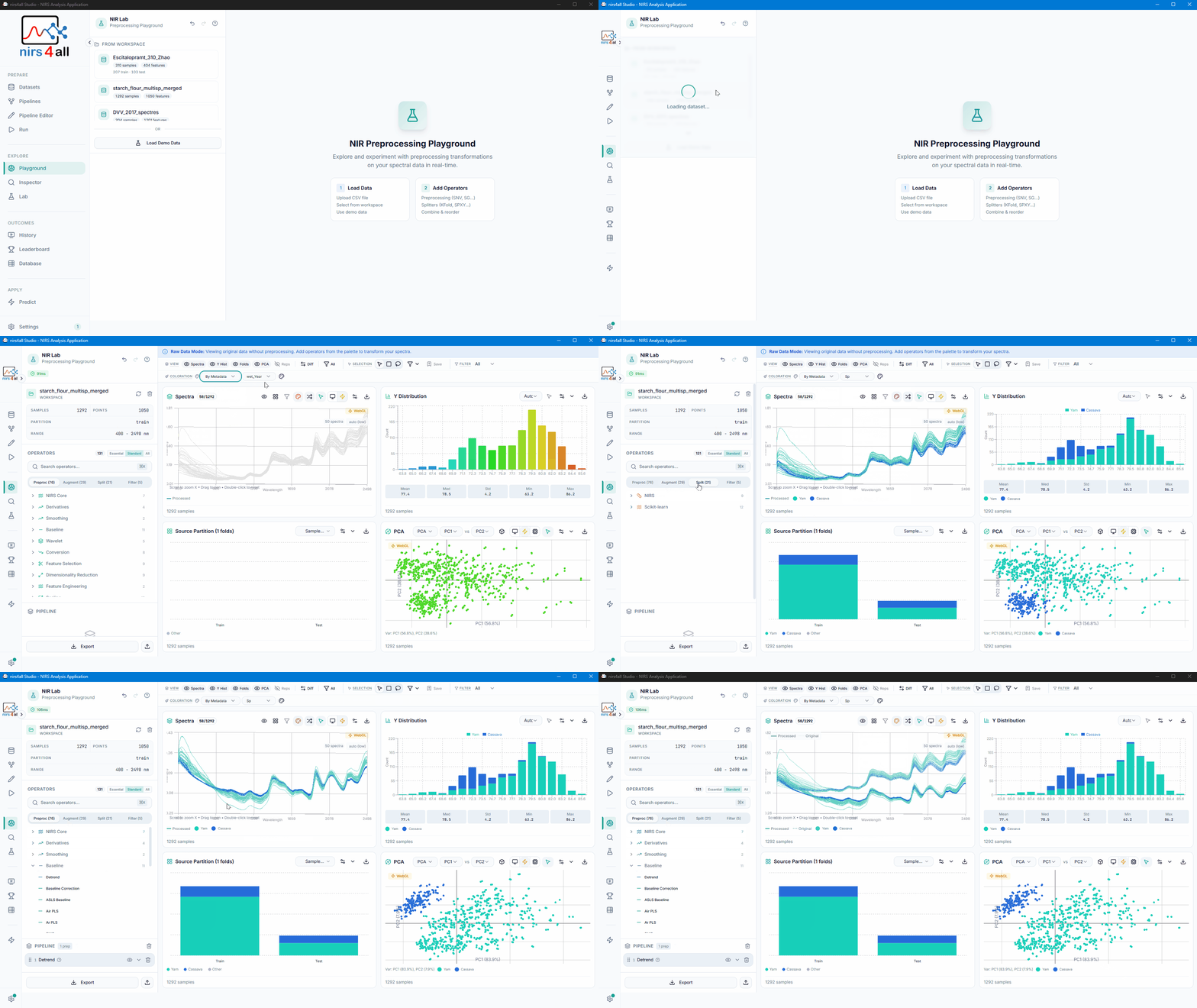
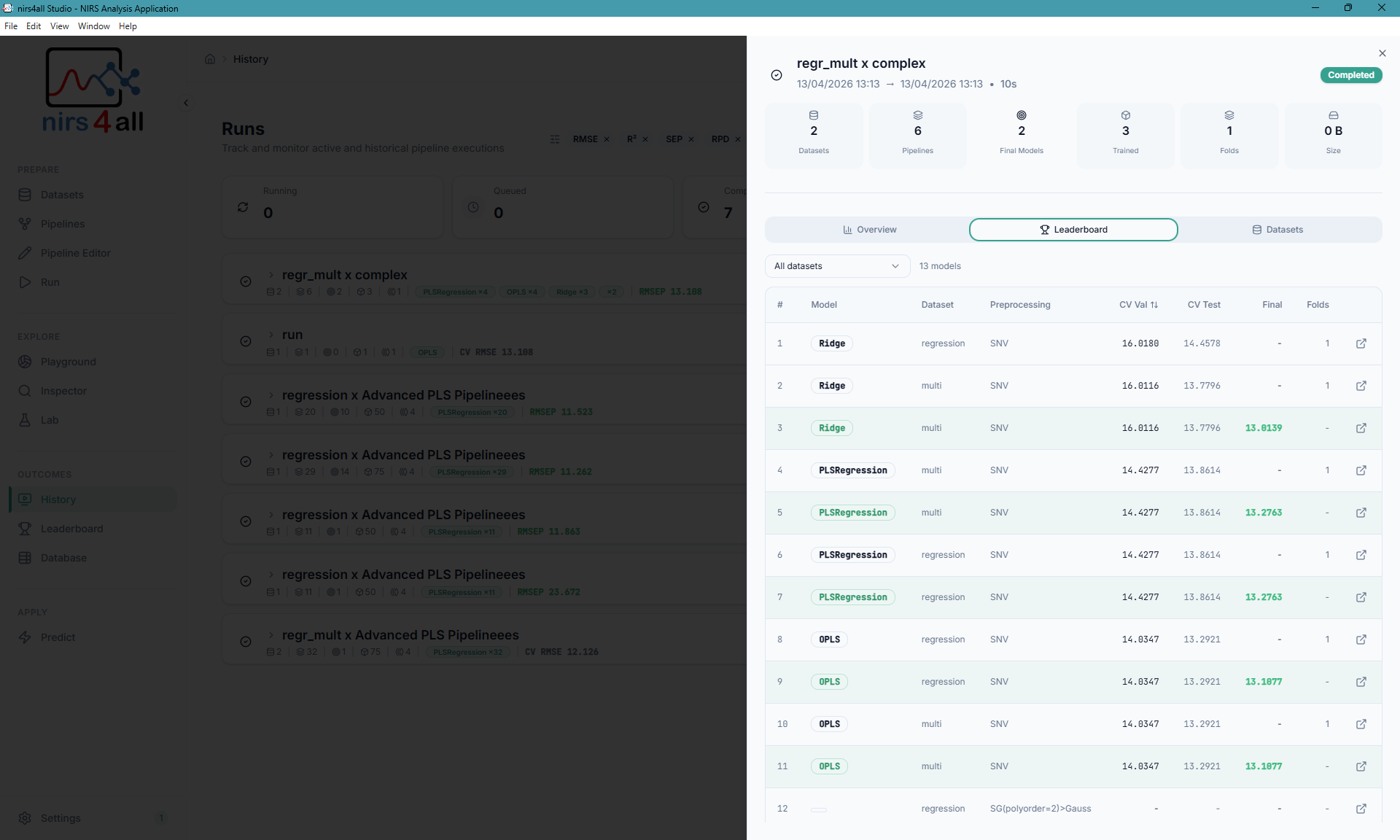
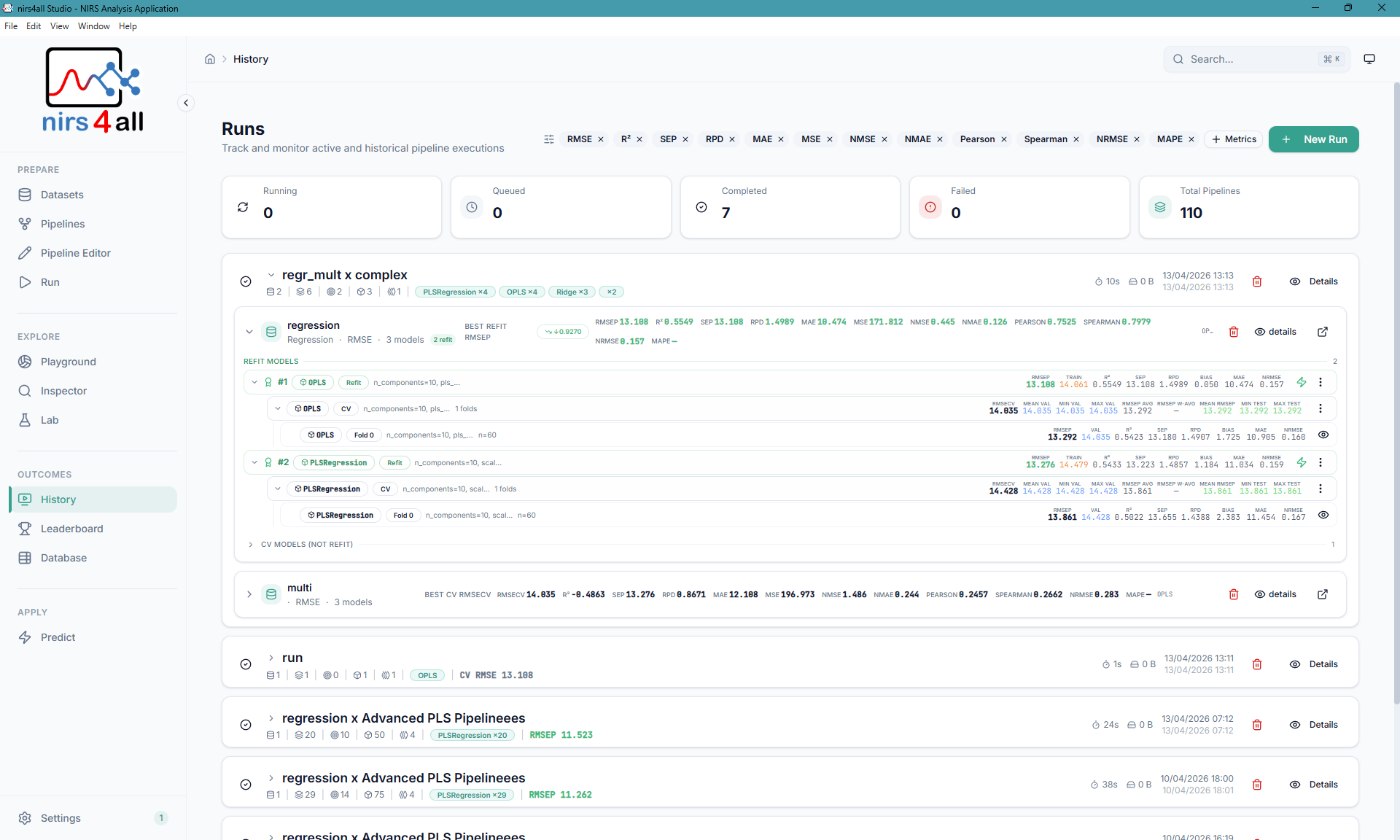
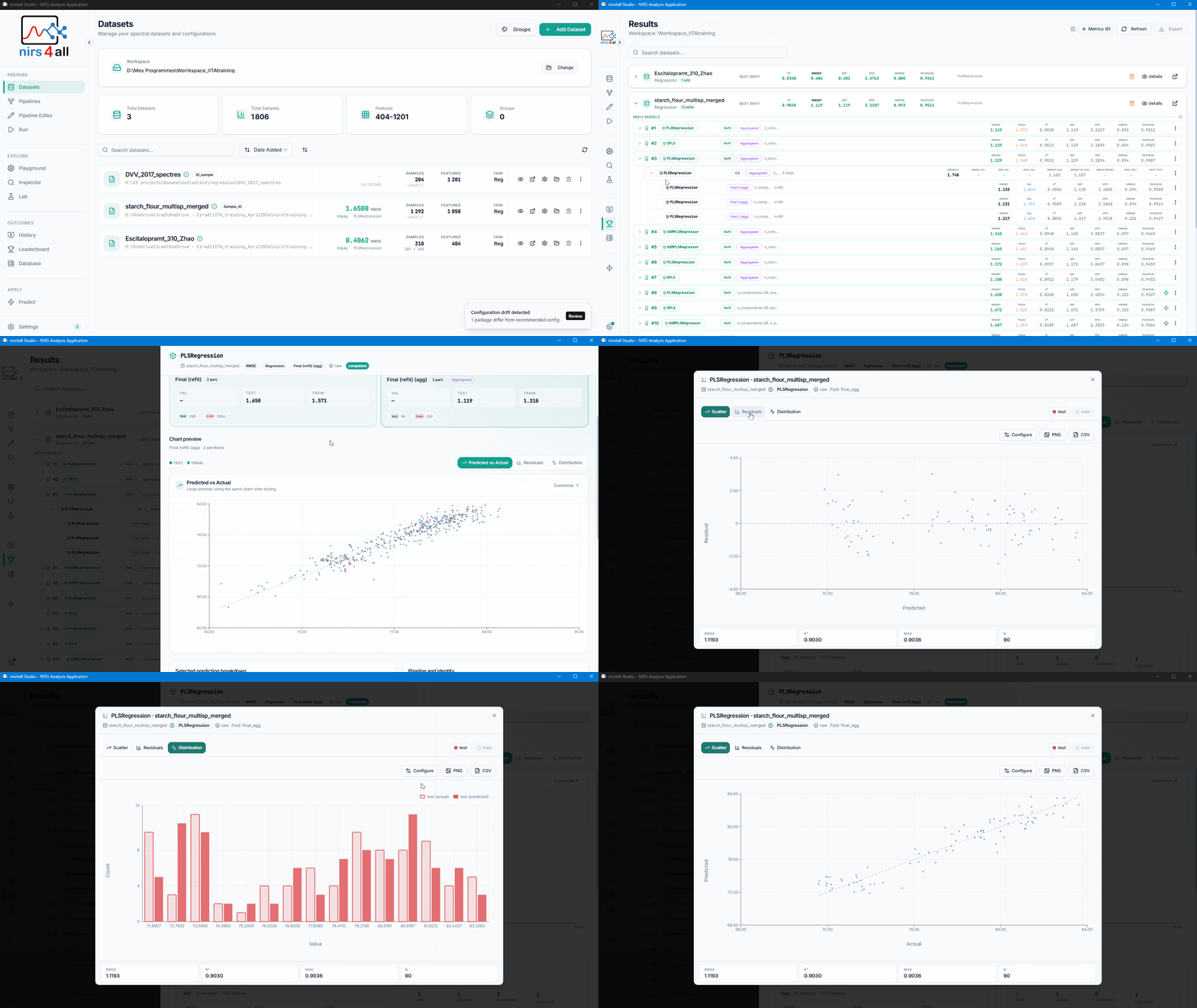
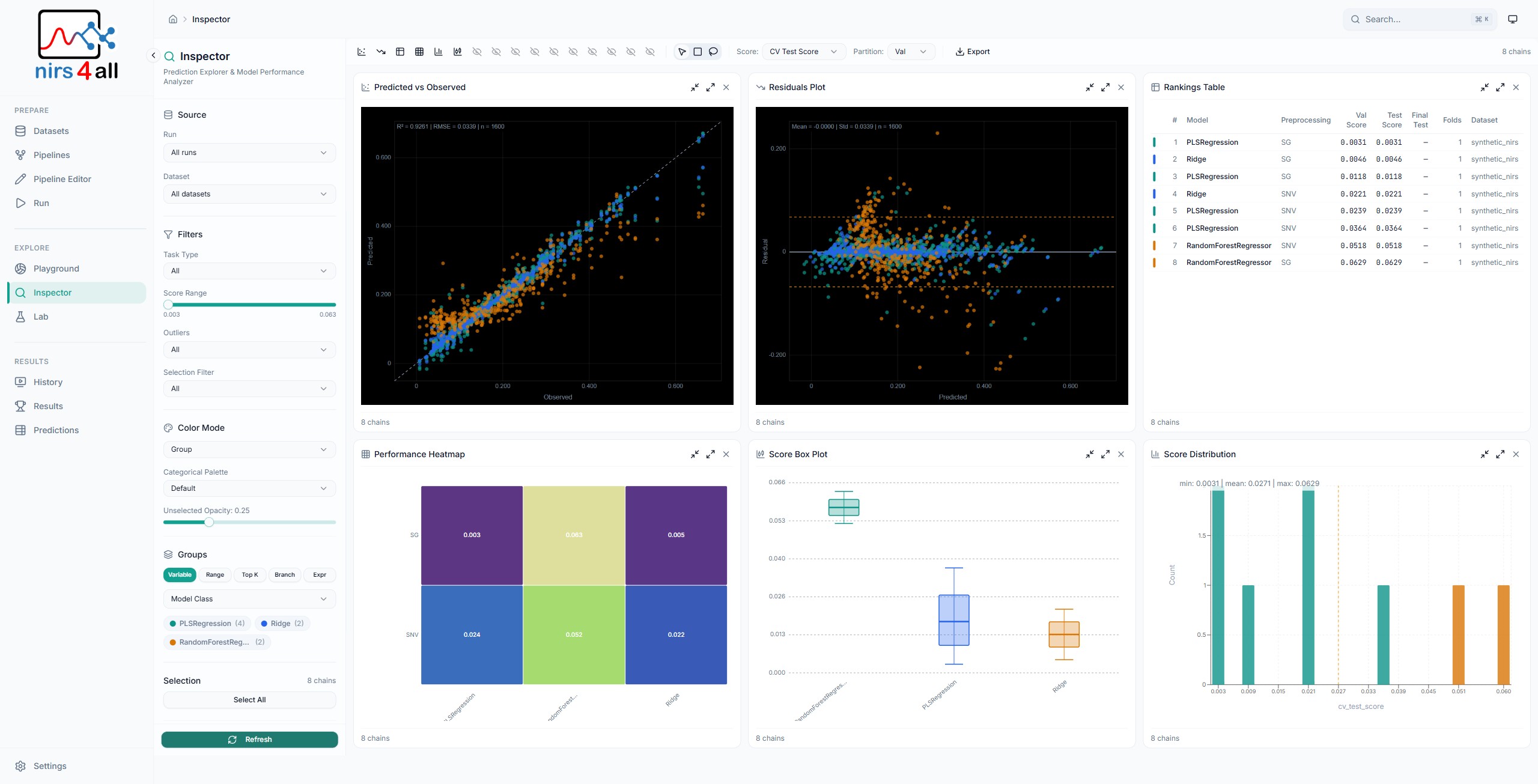
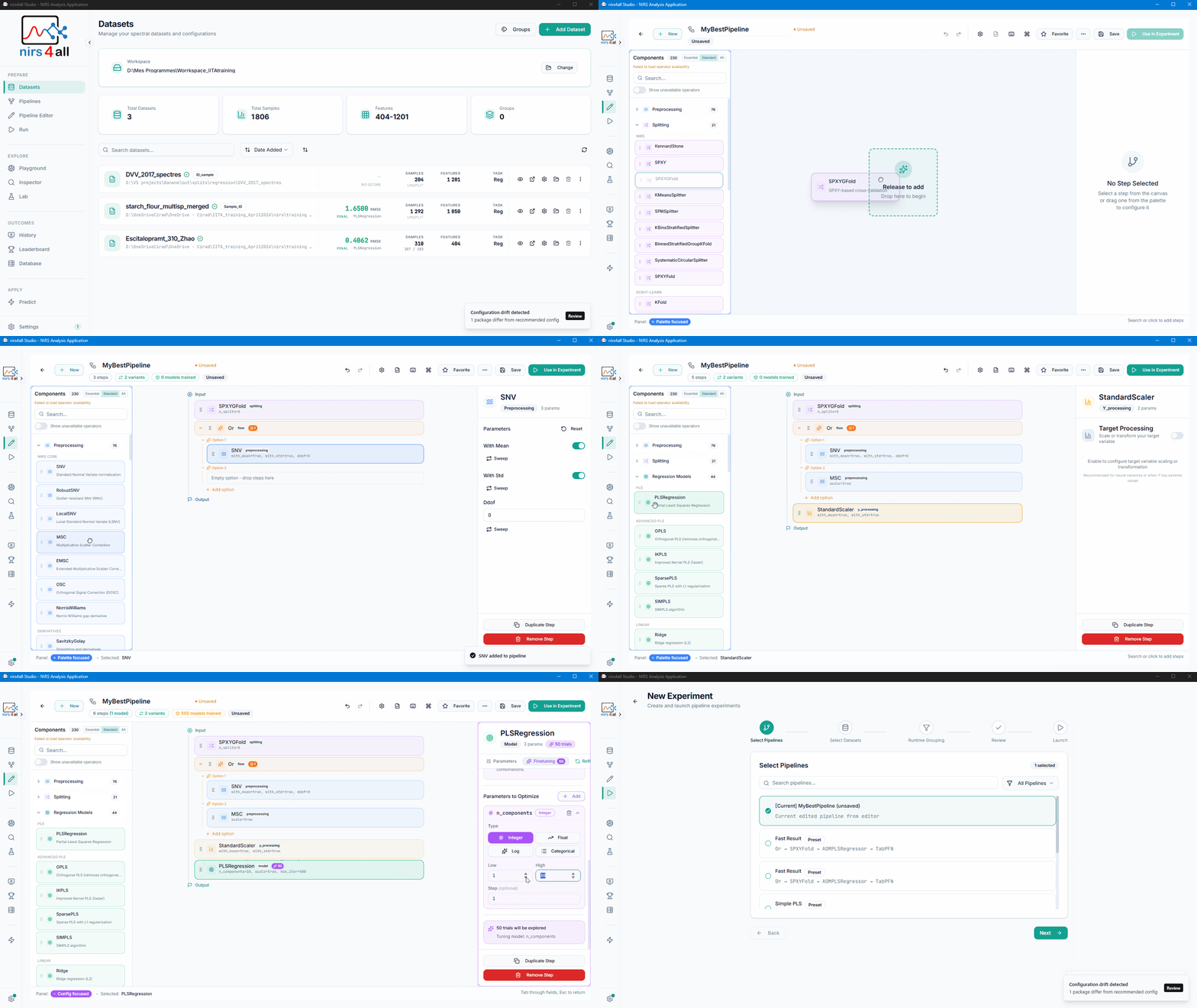
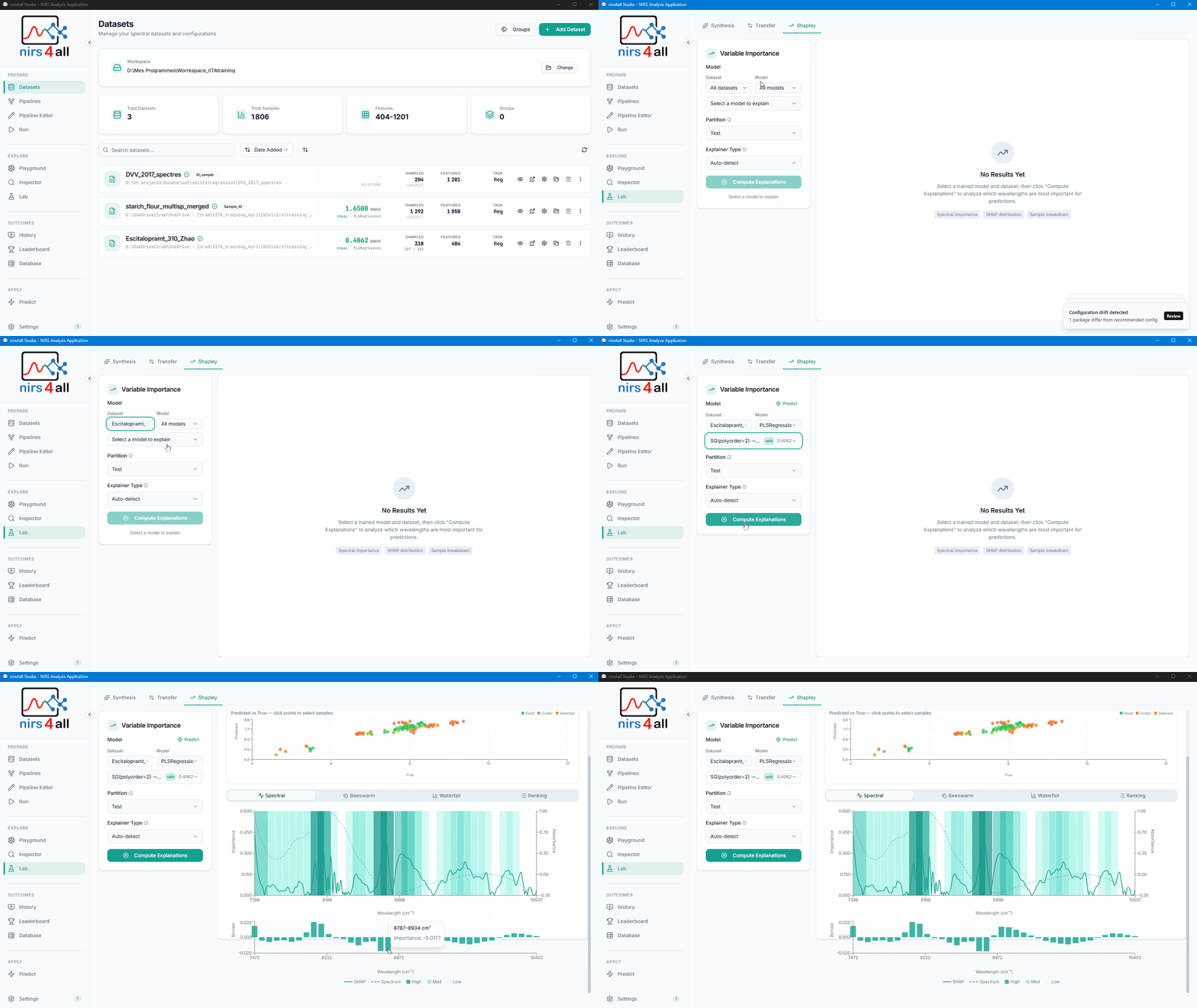
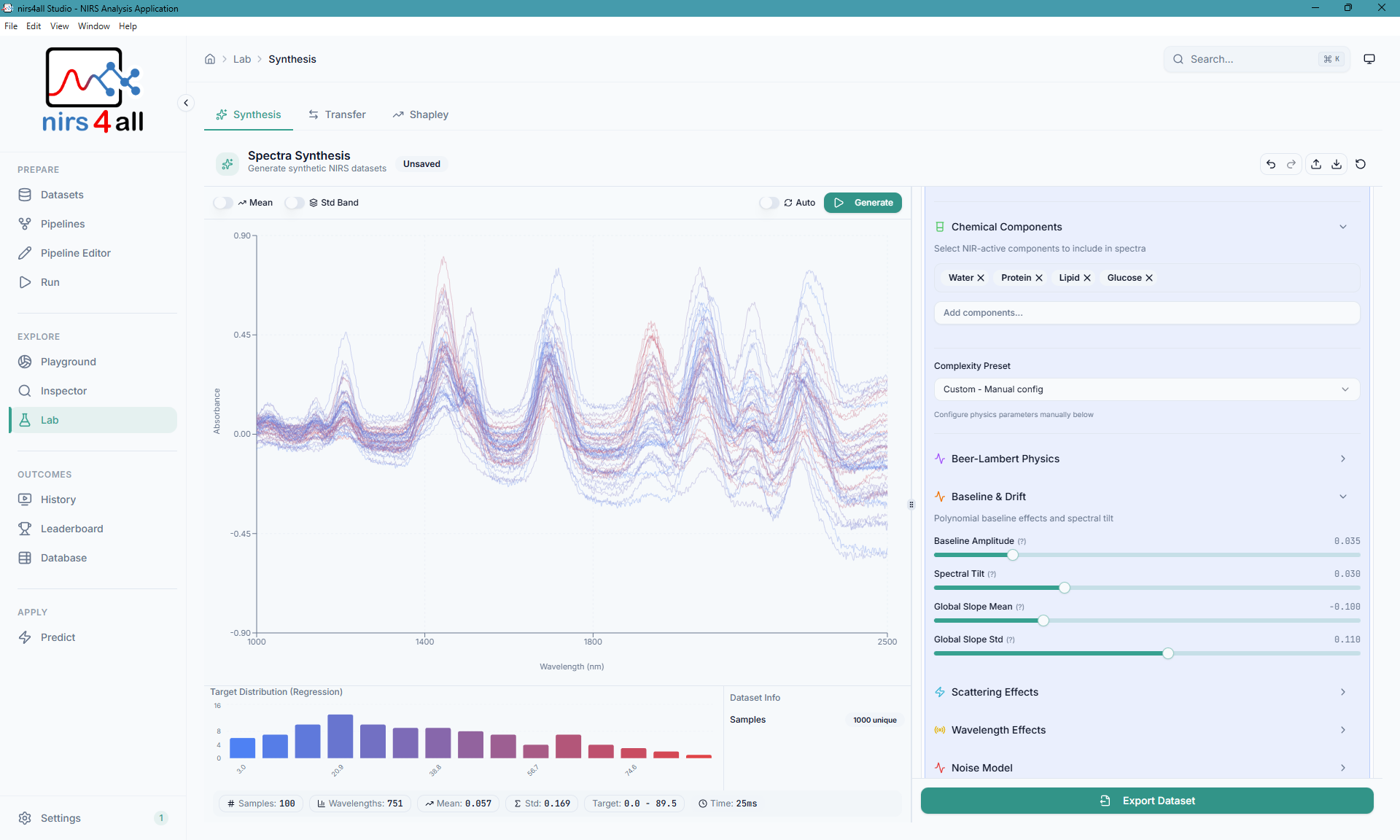
Visual tools for exploring datasets, creating pipelines, running experiments, and inspecting predictions. A native backend with a bundled Python runtime, pipeline nodes generated from the nirs4all-methods catalog, one installer per operating system and a Docker image.
The R product package: composable NIRS pipelines on the native nirs4all-methods engine (n4m) with R learner controllers, a native DAG-ML path, and recipes and trained models shared with Python and the browser.
quali
Guided lab workflow
quali-nirs4all React · WASM
Beta
A guided mini-studio for NIRS analysis laboratories. It helps lab technicians assess spectral data health and repeats, select samples for HPLC or wet chemistry, calibrate models, qualify prediction reliability, and monitor model drift — all locally in the browser through the nirs4all WASM stack.
dev
Connected spectrometer app
nirs4all-device Mobile · BLE
Prototype
A prototype phone and tablet workbench for Bluetooth-connected NIRS spectrometers: organize field sessions, capture and inspect spectra, apply quality gates, and run portable inference locally. The hardware design files and build guide for a DIY NIRS device will be available soon.
ui
Shared UI package
nirs4all-ui React · TypeScript
v0.1.15
The shared React UI and visual-system package for Studio, Web, and custom hosts: reusable presentational components, runtime status view models, score helpers, default CSS tokens, generated brand metadata/assets, and packaged motion motifs, while host apps keep routing, data fetching, execution, icons, and app state ownership.
n4m
Method engine
nirs4all-methods C++ · C ABI
v1.3.4
The portable NIRS method engine: 213 catalogued methods in C++17 behind a stable C ABI (libn4m), 208 of them through generic typed roles — transformers, selectors, regressors, classifiers, sample filters, splitters and augmenters — with a native manifest and a portable fitted state. The same classes are generated for Python, R, JavaScript/WebAssembly and Rust; MATLAB/Octave and Android bindings cover the classic API.
aom
Adaptive models
nirs4all-aom Python · sklearn
v0.10.4
Operator-adaptive calibration models — AOM-PLS, POP-PLS and AOM-Ridge — that fold spectral preprocessing directly into the model and replace external preprocessing grid-search. scikit-learn compatible; companion code for the AOM-PLS paper.
fmt
File readers
nirs4all-formats Rust
v0.2.11
Rust-first, low-level readers for ~58 NIRS & spectroscopy format families. Content-sniffed, lossless, provenance-tracked records with Python, R, WebAssembly and C bindings — the messy vendor-file zoo turned into one clean data model. Try the full reader catalog right in the browser via the live demo.
io
Dataset bridge
nirs4all-io Python · Rust · R
v0.2.6
A dataset-assembly bridge: turn any input — a folder, a glob, vendor spectra plus a reference table, or a config — into a pipeline-ready dataset through resolve → infer → configure → materialize, with a score-based inference engine. Built on nirs4all-formats.
ds
Reference datasets
nirs4all-datasets Python
v0.3.11
A Python library that transparently pulls curated, hand-picked NIRS test datasets from Dataverse — turning reproducible, DOI-citable benchmarks and lab experiments into a one-line import.
dag
Execution core
dag-ml Rust · C ABI
v0.3.41
A leakage-safe, in-process DAG execution core. It owns the graph, phases, folds, out-of-fold joins, lineage, caching and deterministic RNG, and runs multi-model campaigns: many candidate pipelines scored on identical folds, deterministic selection, stacking with nested out-of-fold predictions, HPO, refit and replay. Its controllers for the nirs4all-methods roles derive from the Methods manifest; everything is exposed through a C ABI, Python and WebAssembly.
dat
Data contracts
dag-ml-data Rust · C ABI
v0.2.13
The data-contract and planning layer beneath dag-ml: typed, sample-aligned, multi-source data views, representation adapters, data plans, and schema fingerprints — the foundation that keeps pipelines reproducible.
clu
Distributed execution
nirs4all-cluster Python
v0.1.4
A trusted-LAN beta for distributing nirs4all.run() across lab machines — FastAPI coordinator, SQLite queue, capability routing and crash-safe leases. It is a validation bench, not a public multi-tenant service.
web
Browser client
nirs4all-web WASM · JS
v0.4.1
The browser-native client at web.nirs4all.org. It runs in the page through WASM: load spectra, build a pipeline from the nirs4all-methods catalog, train, score and predict — entirely client-side, with no Python runtime and no server-side analysis. Models are saved as portable native states that Python and R can replay.
core
Portable V1 aggregate
nirs4all-core Rust · Python · R · WASM
v0.4.5
The published portable aggregate for the reproducible cross-language stack gathers dag-ml, dag-ml-data, formats, IO, datasets, and methods behind one coherent V1 integration surface, and reads and writes the trained-model envelope shared by Python, R and WebAssembly.
Reproducible, scored nirs4all pipelines run on curated reference datasets, published as a browsable benchmark resource with interactive dataviz (leaderboards, effect analysis, 3D landscapes, clustered pipeline graphs). An early prototype — currently a static client-side demo; a live meta-analysis service is planned.
re
Pipeline library
nirs4all-repository
v0.1.12
A public beta catalogue of pre-configured nirs4all & dag-ml pipeline recipes stored with provenance, checksums, reference dataset hints, and per-recipe evaluation status. Treat published entries as draft/community recipes unless their catalogue record is marked validated.
pa
Repro publishing
nirs4all-papers
v0.2.3
An early prototype that turns a finished experiment into a self-contained reproduction document — an auto-generated methods & bibliography report alongside an in-browser page that re-runs the exact pipeline, on the bundled data or your own.
prov
Provider clients
nirs4all-providers Python
v0.2.11
The dependency-light, soft-importing provider client layer over nirs4all-datasets and nirs4all-repository. Benchmarks and papers keep their own public APIs. It stays read-side only, with optional-dependency contracts and local export helpers, without owning NIRS, ML, IO, parsing, or write-back logic.
tool
Migration toolkit
nirs4all-tools Python · CLI
v0.0.7
The published V1 preservation toolkit for legacy content: read-only inspection, dry-run, resumable copy-only output and checksum verification. Code 0 means successful preservation; semantic conversion fails closed with code 20, and code 10 is reserved for a future best-effort transform.